

Φ.1 : The Wavefront Model
Cause, Effect and You

I want to say something to you, the reader.
You matter.
Not because of fame, fortune or power.
Not because you are kind or good or courageous or faithful.
Not because of who you love and who loves you.
Not even because you believe it to be true.
There is no such thing as a small life.
There is no such thing as a small act.
The whole history of reality made you who you are.
The whole of the future will reverberate with every single thing you do.
None of us can be gone.
Not really - even those who never survived to be born.
They were, and that means reality is changed by them.
All of us together, echo for eternity.
This is not a motivational speech.
It’s not a sermon.
It’s the fact of causality.
Come, let me show you.
The Dance of Puppets
Let’s start with a simple question.
Have you ever given any thought to whether the decisions you make are truly free?
Did you have the option of choosing differently?
Did you even choose at all?
The obvious answer is yes, because that is what it feels like. Sometimes we mull over the decision, even simple ones like what to eat for dinner, or what series to stream, these can feel the hardest because there are so many options. Often it doesn’t feel like we have no choice, it feels like we have too much.
There is a millennia old debate between two points of view, on the one hand those, libertarians (not related to politics) who say yes of course I have the free will to choose, I can watch myself doing it! On the other hand are those, determinists, who say actually no, free will is just an illusion. It might look like a choice but that is an effect and the effect is the result of past causes, so you couldn’t have chosen any other way.
So are we puppets moved by causality or are we the puppet master enacting our will?
In the conventional telling both sides are problematic. Free will requires there to be something inside us which is not moved by causes in the world but is able to effect them. A magic part of us that doesn’t obey the laws of physics and enables us to do what we want. That can’t be the brain which is physical. So maybe it is the soul or some other mechanism that escapes the causal chain? The position is not compatible with our scientific understanding.
Determinism has the opposite problem, effect following cause is the foundation of scientific thought, but simultaneously this view strips us of agency and renders us incapable of moral action since we had no choice but to act as we did. Leaving our existence essentially meaningless, and us just actors reading a script. There are many nuanced positions and differing interpretations but these are the broad brush strokes.
The Nexus and the Wavefront
There are some, like me, who believe some account of free will is compatible with determinism, yet I differ from most. Imagine if you will, a single point, a nexus, moving forwards through time. That nexus is you.
Behind you, in the past, is everything that has ever happened since the beginning of the Universe. Every single event. Every galactic cataclysm, every particle interaction, every thought or gesture or act of love or violence in all our long history has manifested this reality and you, exactly as you are. With all your experiences and preferences, all your beliefs and ideas, your habits and your attitudes.
For you to be different than you are now would require change to propagate backwards all the way to the beginning, the entire Universe up to this point would need to have been different. Think on that a moment. If effect follows cause all the way back to creation in an unbroken chain then, for you to have had something different for breakfast, the whole sequence of creation would need to be different. You can’t just change one little bit because it is all connected.
You are exactly who you are meant to be and the only person you could be.
Though, that is not even half the story. That little nexus, with the whole universe at its back acts in the present moment. All moments require some decision or some action, even just to do nothing much. Whatever action is taken it is both an effect (of all that came before) and a cause (of all that comes after). We’re usually pretty good at understanding the immediate effect of our actions, if I let go of something it falls, if I hit my head it hurts, but we quickly lose the ability to track the cascading impact.
Maybe you heard the following proverb, a cautionary tale of unforeseen causality:
For want of a nail the shoe was lost,
For want of the shoe the horse was lost,
For want of the horse the rider was lost,
For want of the rider the battle was lost.
All for the want of a nail.
Almost all the effects of our actions are invisible to us. You may be forgiven for thinking the impact dissipates with time, sometimes it does but the opposite is often true. Frequently effects snowball in unpredictable ways. Tiny decisions, chance meetings, even inertia, set in motion the shape of our lives, our lives propagate outwards and Universe is never the same again. That never stops. You’re here reading this because of the decisions my ancestors and your ancestors made two hundred generations ago. In two hundred generations time the world will be meaningfully different for us having lived. And so on, and so on, all the way out to eternity.
If you ever doubted that you matter - don’t.
Every moment of your existence you are in communion with, and shaping, eternity.
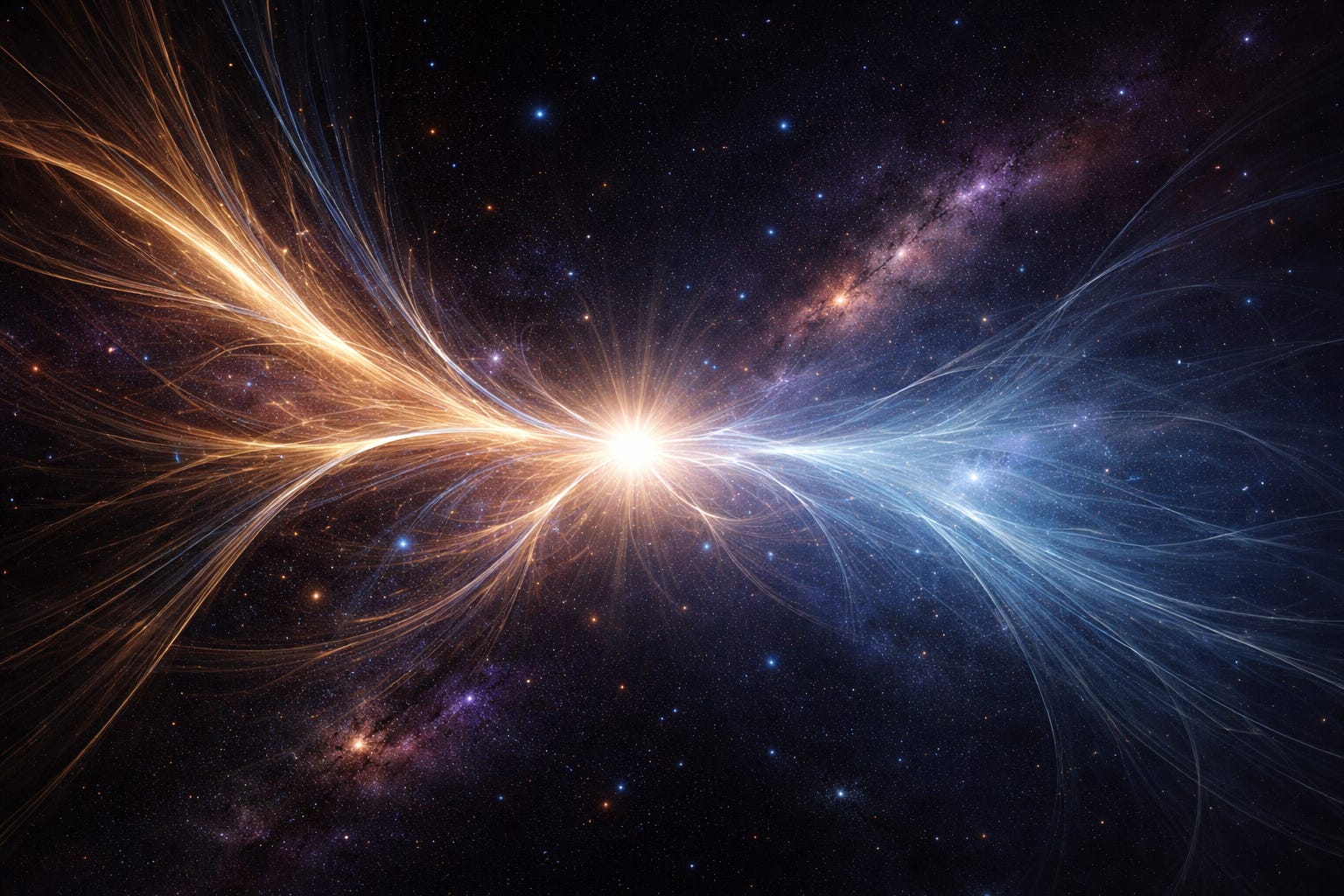
I’ve described but a single nexus of causality, now imagine all beings and all things, in every moment, each one its own nexus. Together they form a wavefront, a causal surface moving through time, taking and reshaping reality moment by moment, each contribution changing the whole now and forever.
An Agent Calls
That wavefront model suggests that meaning need not be absent from determinism after all, but that still does not tell us whether we have freedom to choose.
Before we get to that, first I need to move the goalposts a bit, because that agency we do have doesn’t live where we usually look.
Let’s explore a decision, and look at the actual mechanism of choice.
I have a chocolate bar, it’s looking pretty good right now, but I’ve been saying I want to cut down on eating junk. I’ve been disciplined. So then don’t I deserve a reward? But then I will be annoyed at myself. You get the idea, it’s a dilemma!
So how do I actually arrive at a decision. Determinism suggests that all prior causes combine into current reality, that includes my genes, my life experience, my upbringing, my beliefs, my mood, my culture, my habits, my attitudes, my intentions and so on, all feed into that decision point. All embedded in my thinking, in my memories, in my neural pathways, conditioning unconscious processes and evaluated in my rational, verbal mind. All those competing and balancing factors result in the see-saw of indecision I described above. So does the rational, chatterbox in my head make the final decision, like a judge weighing evidence?
Surprisingly no, not necessarily, there is a growing body of evidence from neuroscience that quick decisions in particular may be driven by subconscious processes. That maybe the decision is made unconsciously and only later do we become consciously aware of it. The executive chatty part is then in charge of PR, it rationalises the decision after the fact. It still feels to us like we made the decision because of signalling mechanisms in the brain. This is not proven but if you have had a really hard decision to make, you may recognise that your ‘heart’ makes up its mind before your ‘head’ catches up.
The slower the decision, the greater the opportunity for executive mind to exert our will through intention but even then the actual decision maker may be unconscious. The science is not fully settled but it does weaken the idea we are wedded to that the executive part of the mind is the boss, who calls the shots and ‘drives’ us around like a meat puppet. At best this is only partially true.
That might appear to close the door of free will in practical terms, and indeed that is the conclusion of many a determinist, but I’m still not done yet.
One of the most salient features of living things is that they are able to model their environment. They understand facts about the world, about how it works because they need to in order to survive. Even the simplest bacteria can move towards food and away from predators. It is that responsiveness that makes them alive in any meaningful way and distinguishes them from rocks and the like.
In that regard I suspect there is no great qualitative difference between a bacteria and something like a dog, which is obviously much more sophisticated with a much richer inner life and decision making capacity. There is no doubt a dog thinks, whereas I wouldn’t say that of a bacteria, however a dog still only attempts (I suspect) to model the world. They realise that if they act there might be some benefit or disadvantage.
We can’t be certain of the complexity of animal cognition but beyond a certain point meta-cognition (thinking about thinking) allows humans and maybe a few other higher primates and cetaceans to do something qualitatively different. We model our environment for sure, but we also model ourselves and we model ourselves as causal agents. That is we don’t just act, we act in the knowledge that our actions will propagate causally. That there will be a downstream impact to what we do. That in effect we have a responsibility for our actions that extends beyond us.
We are the point at which the great chain of causality folds in on itself.
Causality becomes aware through us.
Here is the crux, freedom arises because we realise that though we cannot choose prior causes, and we cannot necessarily make conscious decisions in the moment, we can change our nature as a causal agent.
Causality itself refracts through us. If we change our tendencies, our habits and our attitudes we can change the agent we are for future decisions. The slow deliberate choice of setting our intentions, and aligning our dispositions to those intentions is the real seat of causal agency.
Granted this is not the same kind of agency we have come to associate with free will, it is something more diffuse and slower. It is also older, ancient traditions like Stoicism and Buddhism were organised around cultivating the self, I suspect for the same reason.
The Unexamined Life
The goal is that the subconscious processes that influence decisions are aligned with our will, our chatty executive. Then decisions we make, even in the heat of the moment, are more likely to represent our deliberative will. There is no guarantee, we can’t know how we will react to the unimaginable. Neither is there limit to the degree of our cultivation or to the skill with which we wield ourselves as a nexus of causality.
Socrates is supposed to have said “The unexamined life is not worth living.”
You can imagine that if your beliefs and attitudes were simply inherited, if you never stopped to think about what you wanted from your life, what gave you meaning, to find the things you were blind about then in a real sense you are acting a life reading someone else’s script. That doesn’t feel like freedom.
By contrast examination or cultivation is the process by which you can develop the freedom to make your life your own to the greatest degree possible. It’s not a quick fix, you still have to pay the bills and deal with crap but at least it is in the service of a life you choose.
So what does cultivation and examination actually entail?
There is no single path, very generally any time you are learning is cultivation.
That can include formal education but also reading, experiencing, expressing yourself in whatever way suits you. Anything which stretches you, challenges you, scares you (in a good way) is a form of cultivation.
I’d recommend engaging with philosophy, it is very good at encouraging you to challenge what you hold to be true, at challenging what you think you know, and helping you refine your model of your reality and yourself.
If you are inclined toward something more structured, check out Stoicism and Buddhism as a starting point, both are sophisticated systems of personal cultivation.
Circularity, Regression and Recursion
Did you see a contradiction in my argument?
If you are the product of all past causes then how do you suddenly decide to cultivate yourself? Surely the necessary conditions are already in place or they are not? Isn’t the argument circular. If the conditions are not present then it’s not your fault you are the product of all causes regressing back to the start.
It’s not wrong, but it’s not an objection rather it’s better understood as a clear argument for this very model. Whether or not we engage in cultivation is already determined by prior causes, cultivation isn’t an escape hatch nor is it magical, we will always be determined but cultivation asserts the extent to which we are determined by ourselves.
The Wavefront is curiously recursive, simply knowing about it is an act of cultivation, since it seeds the idea of cultivation and clarifies your understanding of yourself as causal nexus.
It changes your relation to causality, making what was vaguely intuited explicit which is exactly the purpose of cultivation.
We are not alone, of course, the nexus is really a wavefront, we build reality together.
So pass this on and give somebody else the clarity of knowing their place in the causal chain and the freedom that entails.
Meaning and Ethics
There are unexpected dimensions to knowing you are a causal agent beyond the capacity for freedom.
Firstly, the point at which we realise our full relationship to the causal chain, is the point at which meaning is born. Meaning comes from knowing our place in the cosmos, in understanding that you both shape reality and are shaped by it.
Secondly, when you know that your actions echo outwards, that consequences extend beyond yourself that is when ethics manifest. Ethics is the result of the burden of responsibility that being a causal agent necessarily entails. The role of cultivation is to increase the skill and wisdom with which you act, and that is both meaningful and ethical in itself.
A dog cannot experience meaning the way we can because it does not model itself causally, it responds to its environment and the other beings it encounters but does not model its own role. Similarly a dog does not conceive of ethics because it doesn’t have a model that accounts for responsibility for the consequences of its actions.
We do have such a model, and with it freedom comes hand-in-hand with ethics and meaning. The model is not sufficient to explain meaning and ethics but I think it is necessary.
Most accounts of ethics and meaning see them imposed on reality by human fabrication or divine mandate, I suggest instead they are grounded in our relationship to reality.
To be alive is to act, yet you cannot know the full impact of your actions and are still bound to live with the consequences. Such is the human condition.
I plan future essays exploring these points more fully.
Bringing it Home
Well done if you stuck with me this far!
As I said at the beginning - you matter, more than you might ever have guessed. Nothing you do or fail to do will change that.
Your existence leaves a mark and it never goes away.
Human existence is a constant negotiation between what is fixed by prior conditions and what effect we make of those conditions moving forwards.
We don’t have absolute freedom in that negotiation but we can grow that freedom by growing ourselves.
That seems like a good state of affairs to me.
If this has changed your perspective of yourself, even a little, then the wavefront model is doing its job.
Disclaimer: I want to be clear upfront, I have no qualifications or affiliations relevant to the topics I write about. I love thinking; philosophy in the old-school sense, plus it’s free and keeps me out of trouble.
Hopefully you find something lucid or even novel in what I have to say.
If you do, please take it and use it. l don’t have the training to formalise any of this, but if you do the real work, well then it becomes yours. Still I’d appreciate the barest nod.
If I’m wrong, please argue with me, but go easy, I’m learning on the fly!